
Employee alert calls with voice broadcast
Reach workers who do not check email or the HR app: shift changes, safety instructions, holidays and payroll notices, in their own language, with acknowledgement.
- Reaches the shop floor
- Acknowledgement you can show
- Minutes, not a morning of calls
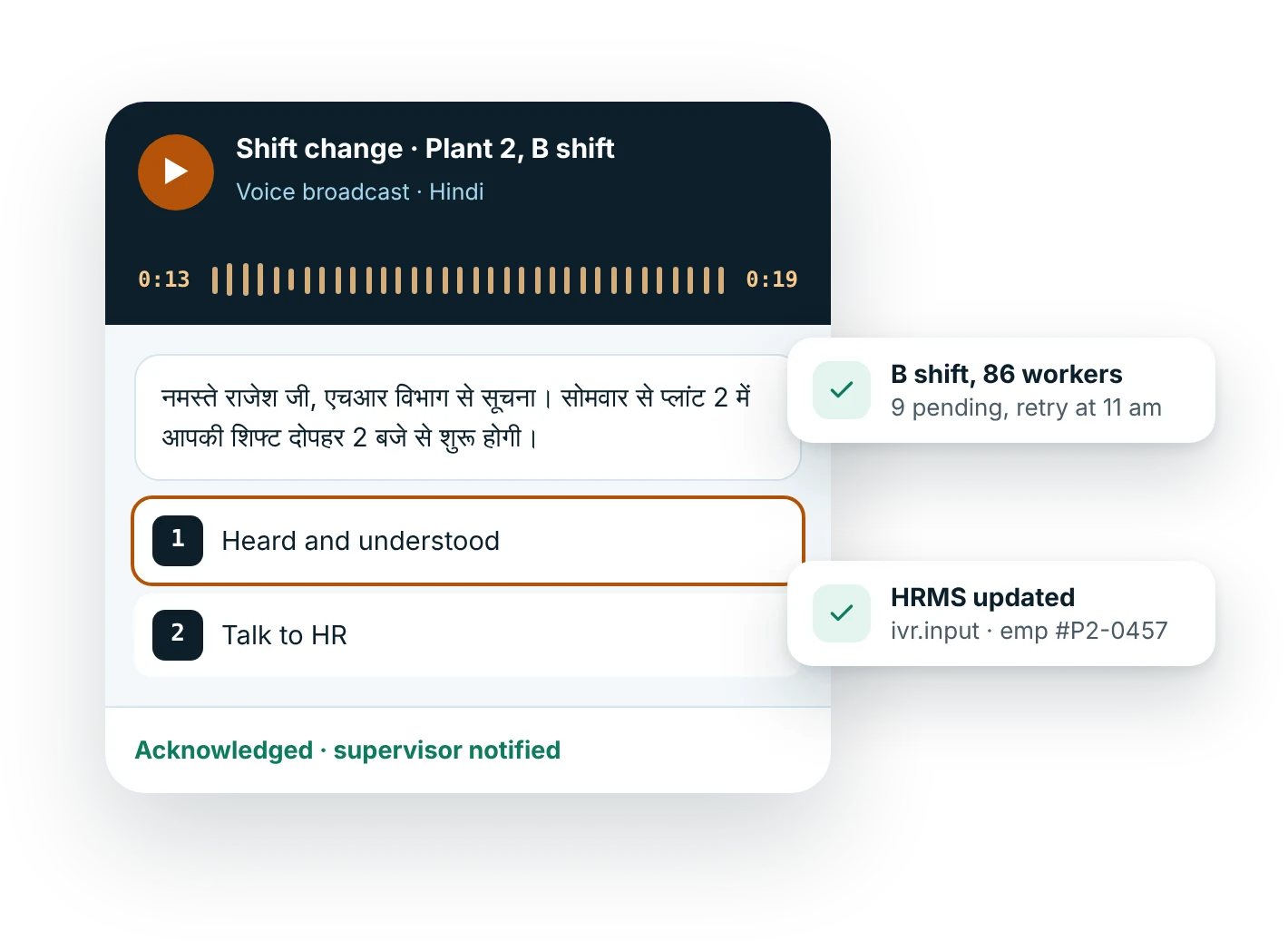
How can companies alert employees with voice calls?
Companies alert employees with voice broadcast by calling a staff list with a recorded or text-to-speech message about shift changes, safety instructions, holidays, training or payroll. Employees press 1 to acknowledge, and supervisors receive a list of those who did not, which suits factories, warehouses, security agencies and field teams without regular email access.
Updated
Why use voice broadcast for employee alerts?
How do you set up employee alerts with voice broadcast?
- Maintain staff groupsKeep employee numbers in groups by plant, shift, site or team, from your HRMS or a sheet.
- Record the instructionA manager records the alert, or text-to-speech reads each employee's name, shift and site.
- Send and retryCalls go out at a time that suits the shift pattern, with retries for those who were asleep or busy.
- Follow up non-acknowledgementsSupervisors see who did not press 1 and reach them before the shift starts.
Call scripts for employee alerts
Copy, edit and use these as a starting point.
Namaste {name}, this is the HR department of {company}. From {date}, your shift at the {plant} plant changes to {shift_time}. Please report to your supervisor, {supervisor}, at the start of the new shift. Press 1 to confirm that you have heard this message, or press 2 to speak to HR.
This is an important safety message from the plant head of {company}. From tomorrow, safety shoes and helmets are compulsory in all areas of the {unit} unit, including loading bays. Workers without them will not be allowed on the floor. Collect your kit from the stores before your shift. Press 1 to confirm.
Namaste, this is the accounts department of {company}. This month's salary will be credited to your bank account on {date} because of the {holiday} holiday. The factory will be closed from {start} to {end} and work will resume on {resume_date}. Press 1 to confirm you have heard this, or press 2 to hear it again.
Record the script or use text-to-speech. Keep calls under 30 seconds where you can.
Which industries use voice broadcast for employee alerts?
What are the best practices for employee alerts?
- Record important messages in the language most workers speak, and add a second language if needed
- Time calls around shifts so night workers are not woken during the day
- Use acknowledgement keys for safety and policy messages and keep the records
- Get consent for work calls when employees join, and remove numbers when they leave
- Acknowledgement rate per group within two hours
- Workers reached before shift start for urgent changes
- Number of supervisor follow-up calls needed
Connect results to your CRM with the Voice broadcast API and webhooks. See how pricing works.
Questions about voice broadcast employee alerts
Do employee alert calls need DND clearance?
Work-related calls from an employer to its own staff are not promotional, so DND preferences for commercial promotions do not apply in the same way. Still, take consent for work calls at onboarding, keep calls to work matters and handle numbers as personal data under the DPDP Act 2023.
Can we reach contract workers through a staffing agency?
Yes, if the agency shares numbers with consent or sends the calls itself. Many manufacturers ask the agency to call its deployed associates about shift and site changes, using the same message the company has recorded.
What time should employee alerts go out?
Fit them around the shift pattern. Call day-shift workers in the evening and night-shift workers in the afternoon, unless it is an urgent safety alert. Avoid calls during sleeping hours for messages that can wait.
Can an employee alert include their name and shift?
Yes, with text-to-speech. Upload a sheet with name, shift time, plant and supervisor, and each worker hears their own details in Hindi or English. Other Indian languages are available on request, or use recordings for fixed messages.
Is a keypress acknowledgement enough for safety compliance?
It is a useful record that the message reached the worker's phone and that someone pressed 1, but it does not replace safety training, toolbox talks or written sign-offs. Use it alongside your existing safety process, not instead of it.
Can employees ask HR questions during the call?
Only by pressing a key to request a call from HR. If you want automated calls where employees can ask about leave, payroll or shifts in conversation, MsgClub AI Voice is designed for two-way calls.
Related guides
More Voice broadcast use cases
Start sending in minutes
Create a free account to test the panel and API, or talk to our team about volumes, DLT setup and CRM integration.